
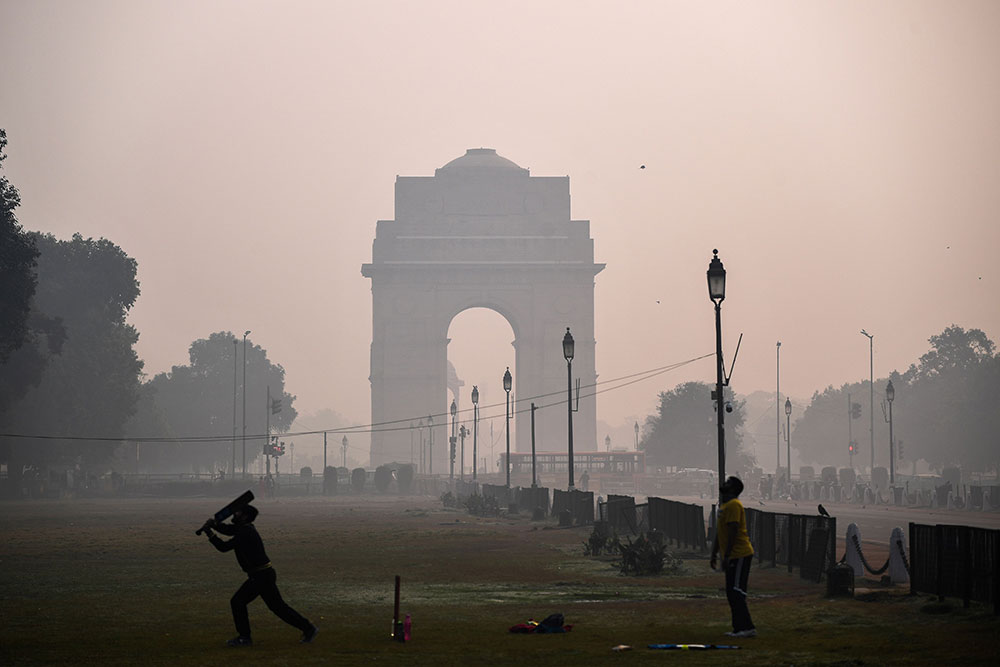
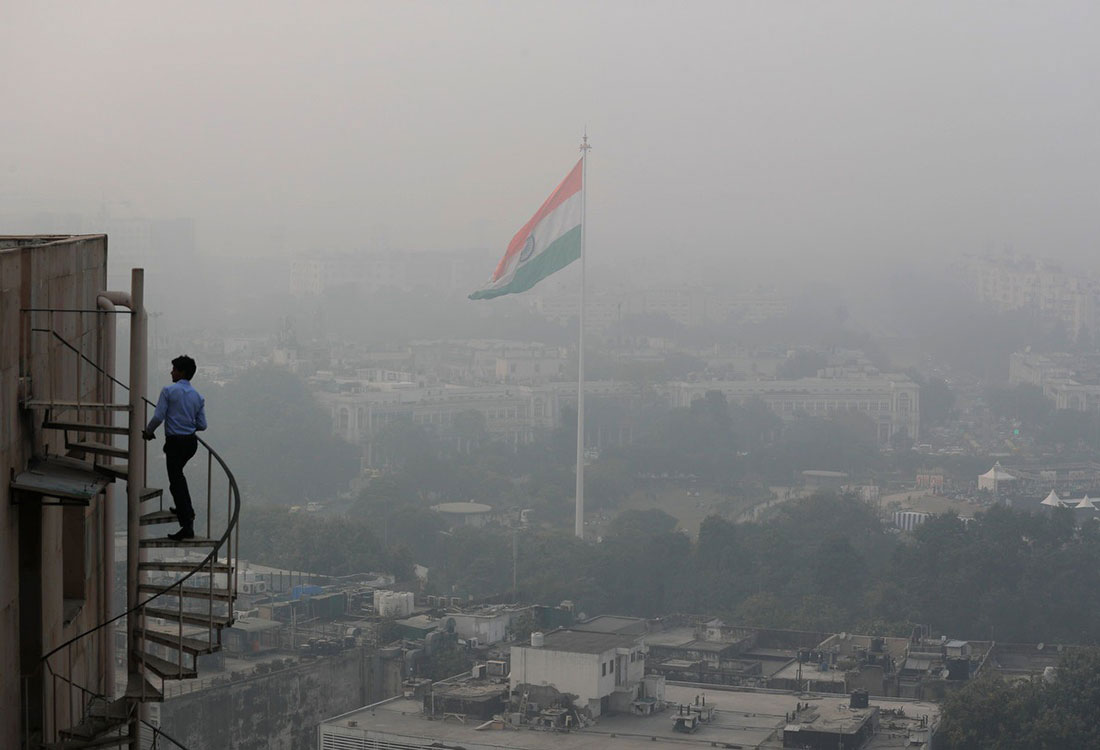
As the new year 2026 began, residents of India’s capital, New Delhi, were greeted not by post-festival freshness, but by a familiar public health crisis. Thick smoke from factors like stubble burning engulfed the city, pushing air pollution to “hazardous” levels, forcing the government to order the closure of all schools and suspend construction activities. Data from the Central Pollution Control Board (CPCB) showed the average PM2.5 concentration in parts of the capital once spiked to 500 micrograms per cubic meter.
Although recent favorable meteorological conditions like strong winds have brought some improvement—with Delhi’s average Air Quality Index (AQI) dropping to 236 on January 2nd—official forecasts predict air quality will remain in the ‘Poor’ to ‘Very Poor’ range in the coming days. This reveals a harsh reality: in India, especially in Delhi and across the Indo-Gangetic Plain, the right to breathe clean air often depends on the mercy of the “wind”. When the weather doesn’t cooperate, the health of our families, particularly children and vulnerable groups, is exposed to invisible threats.
Long-Term “Macro-Environment” Governance vs. Immediate “Micro-Environment” Self-Protection
While the Indian government’s National Clean Air Programme (NCAP) aims to systematically improve air quality, its progress faces multiple challenges. For ordinary households, the effects of macro policies take time. However, health cannot wait. The World Health Organization has long indicated that indoor air pollution can be equally severe. When outdoor AQI soars, closing windows is just the first step, as pollutants still seep in, and indoor sources like dust, allergens, and formaldehyde create a composite pollution threat.
At this point, a truly efficient and reliable air purifier is no longer a luxury but a “essential” piece of infrastructure for safeguarding family respiratory health. Independent of the weather, it works proactively 24/7, transforming your home into a “safe haven” against external pollution.
Choosing a Purifier: Beyond Filtration, to True “Purification”
Faced with a plethora of products, how does one choose? The key lies in understanding the complexity of modern air pollution and the core of purification technology.
Modern indoor air pollution is “composite,” meaning an ideal purifier needs powerful particulate removal (for PM2.5, dust), gaseous pollutant decomposition (for formaldehyde, VOCs), and microbial disinfection (for bacteria, viruses, allergens) simultaneously. The industry trend has shifted from “single pollutant removal” to “composite governance”.
Therefore, focus on these key metrics:
High CADR Value: Represents purification speed. For formaldehyde, high-end models can have CADR values exceeding 600 or even 800 m³/h, rapidly reducing pollutant concentration.
Decomposition-based Formaldehyde Removal: Superior to simple activated carbon adsorption. Decomposition technologies (like catalytic breakdown) convert formaldehyde into harmless carbon dioxide and water, avoiding the potential issue of secondary pollution from saturated carbon filters.
Safe and Efficient Disinfection: Especially important for families with children or sensitive individuals. Prioritize products using “human-coexistence” disinfection technologies (like fully-enclosed UV-C, plasma) with relevant safety certifications, ensuring the process is safe for the family.
Aimbon T3 & T7: Harnessing Nature’s Wisdom, Customizing “Post-Storm” Freshness for Indian Homes
Born from a deep understanding of pure breathing, Aimbon integrates its core “Water-Gate Technology” into product design, offering the T3 and T7 series air health systems that systematically address composite pollution. They are not just appliances but personalized air management platforms tailored for India’s severe air environment.
1. Recreating “Wind, Rain, Thunder & Lightning” for Quadruple Deep Purification
Aimbon’s technological philosophy mimics nature’s most powerful purification process—the thunderstorm. Why is air so fresh after a storm? Because the wind carries away dust, rain washes the air, and lightning ionizes it, creating purifying ions. Aimbon’s “Water-Gate Technology” is a precise engineering reproduction of this process:
Commanding the “Wind” (HEPA Filtration): The system first uses high-efficiency H13/H14 grade HEPA filters, acting like a strong wind, physically intercepting over 99.95% of fine particles as small as PM0.3, including deadly PM2.5, pollen, dust mites, and other common allergens.
Transforming into “Rain” (Water Wash Purification): This is the patented core of Aimbon. The air then passes through the unique “T-shaped Water Purification Filter.” Using capillary action to form a nano-scale water film, it performs deep dissolution, adsorption, and rinsing of gaseous pollutants (like formaldehyde, TVOC) and ultrafine particles, washing away pollutants at their source like rainwater cleanses the earth, while naturally regulating indoor humidity.
Channeling the “Thunder” (Ionic Disinfection): The system simulates the energy field created by lightning, releasing a high concentration of ecological-grade negative oxygen ions. These ions not only further agglomerate and settle micro-dust but also effectively disrupt the protein structures of bacteria and viruses, achieving broad-spectrum disinfection while delivering the vibrant air sensation of a post-rain forest.
Harnessing the “Lightning” (Photocatalytic Sterilization): Higher-end models are equipped with a UV-C photocatalytic module that irradiates the airflow within a sealed chamber, directly damaging the DNA/RNA of microorganisms, achieving a sterilization rate of over 99.9%, as if the energy of lightning is safely harnessed for purification.
2. How the Products Serve Your Family: The Precise Protection of T3 & T7
Aimbon T3 (2-in-1 Air Purification Humidifier): Focuses on the essential combination of “Wind” and “Rain”. It is a powerful tool against daily dust, pollen allergies, and basic gaseous pollution, ideal for medium to small spaces like bedrooms and studies. During Delhi’s dry and polluted winters, its built-in water wash function cleans the air while naturally raising humidity to a comfortable 40%-60% range, achieving two benefits at once.
Aimbon T7 (4-in-1 Medical-grade Air Health System): This is the culmination of the complete “Wind, Rain, Thunder & Lightning” ecosystem. Building on the T3, it enhances the proactive disinfection and deep decomposition capabilities of “Thunder” and “Lightning”. Suitable for large living rooms, it is also a “medical-grade” protective solution for families with newborns, pregnant women, the elderly, or members with sensitive respiratory systems. Facing severe outdoor bioaerosol threats and potential indoor cross-infection risks, the T7 can provide hospital-grade clean air protection, making it the ideal choice for establishing a core health zone in the home.
Conclusion: Take the Sovereignty of Breath into Your Own Hands
While we cannot control when Delhi’s sky will turn blue, we have the full power to decide whether every breath our family takes is clean. Relying on “waiting for the wind” is passive, while investing in an air health platform like the Aimbon T series, based on “Water-Gate Technology,” is an active and intelligent choice.
It means that regardless of how the outdoor AQI fluctuates, your home will always possess a sanctuary guarded by “Wind, Rain, Thunder & Lightning.” This is not merely purchasing an appliance but building a stable, reliable, and comprehensive first line of health defense for your loved ones. Throughout India’s long pollution season, let every deep breath be filled with peace of mind and vitality.