
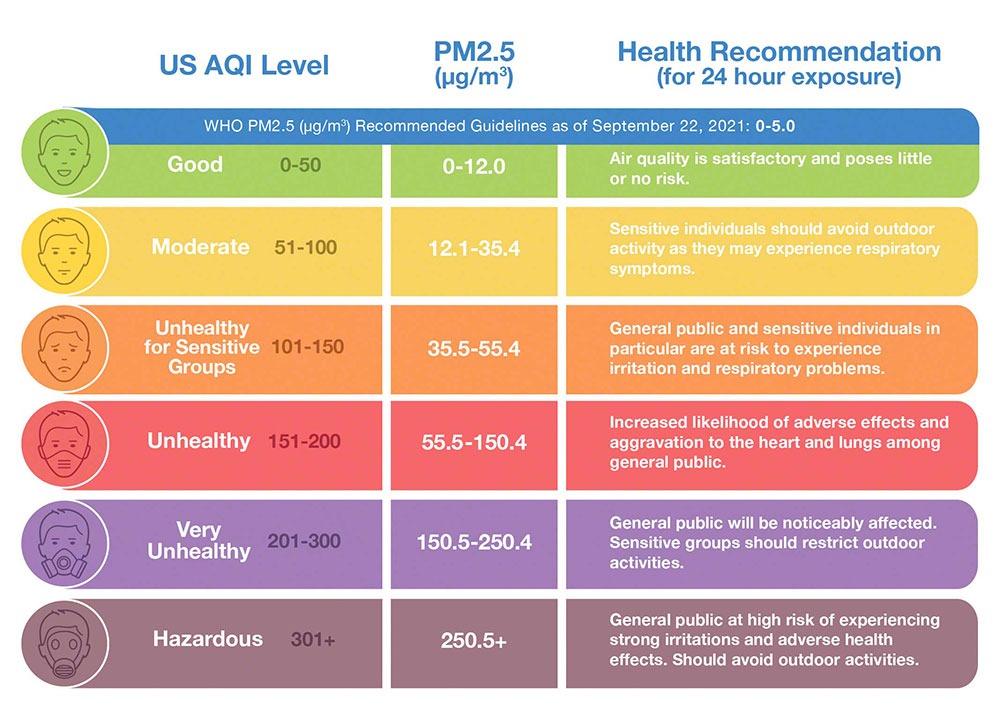
When we discuss air quality, one of the most frequently cited metrics is the AQI (Air Quality Index). Much like temperature or humidity in a weather report, it is a universal scale that translates complex air quality data into a simple, easy-to-understand number and color, helping the public quickly grasp the level of air pollution and its potential health impacts.
Part 1: What is AQI? A Composite “Translator”
The core function of the AQI is to integrate concentration data for multiple key air pollutants into a single number using a unified scientific formula. This provides a more comprehensive picture than looking at a single data point, like PM2.5 concentration alone.
Key Pollutants Monitored: The AQI is typically calculated based on six pollutants that have the most direct and widespread impact on public health:
Fine Particulate Matter (PM2.5)
Inhalable Particulate Matter (PM10)
Ground-Level Ozone (O3)
Nitrogen Dioxide (NO2)
Sulfur Dioxide (SO2)
Carbon Monoxide (CO)
How It’s Calculated and Categorized:
Monitoring stations measure the real-time concentration of each pollutant. The AQI calculation takes the highest index value among these pollutants as the final AQI number. This is because the overall air quality level is determined by the most severely polluted indicator. This number is then classified into different tiers, each corresponding to a specific color, air quality descriptor, and health guidance.
The following is a general AQI categorization table (specific thresholds may vary slightly by national/regional standards):
| AQI Range | Color | Air Quality Level | Implications for Public Health |
|---|---|---|---|
| 0 – 50 | Green | Good | Air quality is satisfactory, with little to no risk. |
| 51 – 100 | Yellow | Moderate | Air quality is acceptable. However, there may be a moderate health concern for a very small number of individuals who are unusually sensitive to air pollution. |
| 101 – 150 | Orange | Unhealthy for Sensitive Groups | Members of sensitive groups (e.g., children, older adults, people with heart or lung disease) may experience health effects. The general public is less likely to be affected. |
| 151 – 200 | Red | Unhealthy | Some members of the general public may experience health effects; members of sensitive groups may experience more serious health effects. |
| 201 – 300 | Purple | Very Unhealthy | Health alert: The risk of health effects is increased for everyone. |
| 301 – 500 | Maroon | Hazardous | Health warning of emergency conditions: everyone is more likely to be affected. |
Part 2: Why is AQI So Important?
The importance of the AQI lies in its role as a critical bridge connecting scientific data, public health, and public action.
An “Early Warning System” for Public Health
The fundamental value of the AQI is health protection. It translates invisible, intangible pollutant concentrations into risk levels that the average person can understand through intuitive colors and numbers. When the AQI displays “Orange” or higher, it acts as a clear health warning:
For Sensitive Groups: It signals the need to take protective measures, such as reducing outdoor activities, closing windows, or using air purifiers indoors.
For Everyone: On high pollution days (e.g., “Red” or “Purple”), it advises reducing prolonged or intense outdoor exertion to avoid inhaling excessive pollutants.
A “Measuring Stick” for Environmental Management and Policy
For government agencies, the AQI is a core tool for assessing current air quality and formulating and evaluating the effectiveness of environmental policies. Long-term AQI data analysis helps identify pollution trends and major sources, providing a scientific basis for targeted control measures like traffic restrictions or industrial emission reductions.
A “Catalyst” for Public Awareness and Environmental Education
The widespread availability of AQI information has significantly increased public awareness of environmental issues. Daily AQI reports encourage people to pay attention to the air they breathe and understand the sources and hazards of different pollutants. This, in turn, makes them more likely to support or participate in environmental actions and adopt greener lifestyles, such as choosing sustainable transportation.
A “Decision-Making Aid” for Daily Life and Activities
Is it a good day to open the windows? Should a child’s school proceed with outdoor activities? Is a mask necessary? Checking the real-time AQI has become part of the daily decision-making process for many, helping them make healthier choices on polluted days.

Conclusion
In summary, the AQI index is a highly successful model for popularizing complex scientific data. It serves as the “common language” and “health dashboard” for air quality. Its importance lies not only in objectively reflecting pollution levels but also in its effectiveness in guiding public behavior, supporting government policy, and ultimately driving society toward the common goal of improving air quality and protecting public health. Understanding and paying attention to the daily AQI is a crucial step for individuals in modern society to practice healthy living and exercise their right to environmental information.