
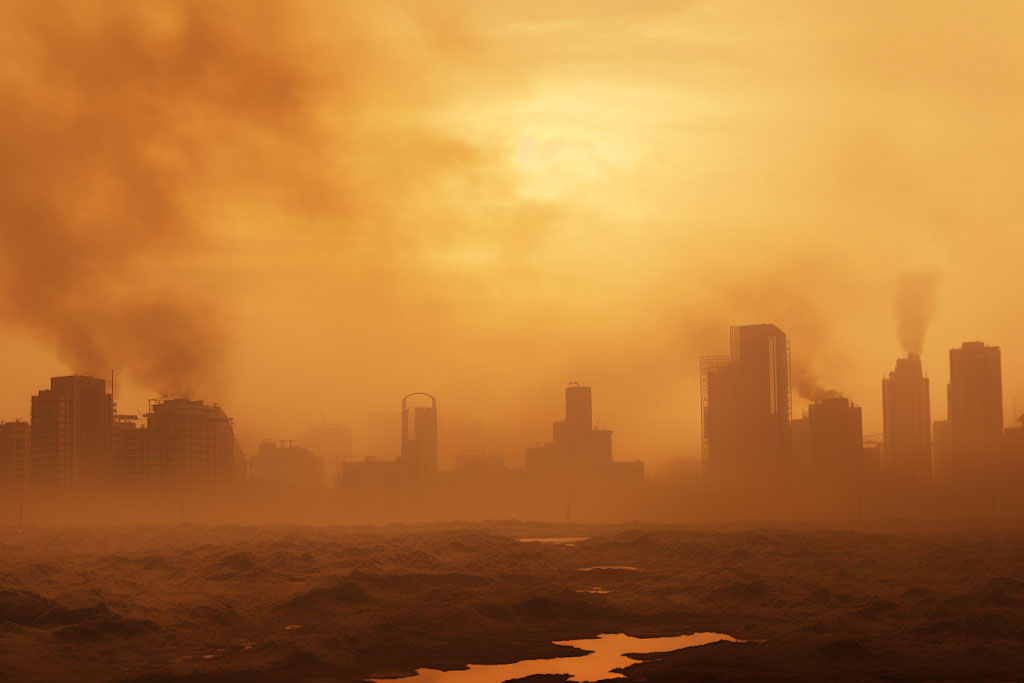
On March 14, 2026, a powerful sandstorm swept through the Gaza Strip, pushing this war-torn region deeper into the abyss of humanitarian catastrophe. Winds exceeding 80 kilometers per hour, laden with dust from the Egyptian desert, tore through the flimsy tents sheltering hundreds of thousands of displaced families, turning the sky an oppressive shade of orange. This sandstorm was not merely a natural disaster; it was an environmental and health calamity magnified exponentially by the context of war.
I. Direct Causes of the Sandstorm: Meteorological and Geographical Factors
1. Formation of a Deep Low-Pressure System
According to monitoring data from Arab meteorological websites, the root cause of this sandstorm was the formation of a deep low-pressure system. Satellite imagery showed that the system originated over Egypt and intensified significantly upon entering the Mediterranean, becoming the deepest low-pressure system recorded in the Eastern Mediterranean basin this season, with a central pressure value reaching approximately 995 millibars.
This type of system, similar to a “Khamsin” depression, is a common spring weather pattern that carries large amounts of dust from the North African deserts northeastward. Meteorological observer Rais Alami confirmed that the strongest gusts occurred in Gaza and the western Negev region, with wind speeds exceeding 80 km/h in the morning.
2. Source of the Dust
The orange sky was caused by the interaction of sunlight with dust particles carried from the Egyptian desert by strong winds. These fine mineral particles were lifted high into the atmosphere by the powerful winds and transported by the low-pressure system’s airflow to the Gaza Strip and surrounding areas.
Reports from Yemeni news agencies also confirmed that the entire Gaza Strip experienced dust-laden storm winds, with the strong winds directly impacting the tents of displaced families.
II. War-Exacerbated Environmental Vulnerability: Why the Sandstorm Was More Destructive
Sandstorms themselves are a common natural phenomenon in the Middle East during spring. However, in Gaza, nearly two years of continuous war have rendered the land extremely fragile, causing a sandstorm of equal intensity to inflict damage far beyond the norm.
1. Collapse of Living Conditions
According to UN estimates, approximately 80% of Gaza’s buildings have been damaged or destroyed in the war. This means that over 1.9 million displaced people—the vast majority of Gaza’s 2.4 million population—are forced to live in two types of places: makeshift tents made of tattered tarpaulin and plastic sheeting, or buildings already severely damaged and at risk of imminent collapse.
Hosni Muhanna, spokesperson for the Gaza Municipality, told Al-Quds newspaper that these temporary tents “lack minimal protection” and are utterly defenseless against harsh weather like sandstorms.
2. Comprehensive Paralysis of Infrastructure
The war has brought Gaza’s infrastructure to the brink of collapse. The Civil Defense Authority stated that, due to a lack of heavy equipment and necessary capabilities, hundreds of bodies remain buried under the rubble. Damaged roads, power outages, and failed water systems have reduced the capacity to respond to natural disasters to near zero.
Muhanna pointed out that, “in the absence of infrastructure, the persistence of these weather conditions will endanger the lives of tens of thousands of people.” He urgently appealed to the international community for intervention, calling for safe alternative shelters for the displaced.
3. The Deadly Consequences of the Blockade
Although the ceasefire agreement that took effect in October 2025 has held for several months, tents, prefabricated homes, and reconstruction materials remain largely banned from entry into Gaza. This means that with every spell of harsh weather, the displaced must face it with the same dilapidated tents, unable to obtain more robust shelter.
The Civil Defense Authority noted that “every wave of harsh weather exacerbates an already fragile humanitarian situation.”
III. Severe Impacts on Air Health
The health threats posed by sandstorms are significant even under normal conditions. In Gaza, these threats are infinitely magnified by the scars of war.
1. Direct Health Risks
The Civil Defense Authority and multiple media outlets explicitly stated that sandstorms pose particular health risks to people with respiratory and cardiovascular diseases. The fine particulate matter suspended in the dust can penetrate deep into the lungs, triggering or exacerbating a range of illnesses.
The Civil Defense Authority detailed the health threats in its statement:
• Aggravation of respiratory diseases: High concentrations of dust in the air pose a direct threat to patients suffering from asthma, chronic bronchitis, and other respiratory conditions.
• Eye allergic reactions: For individuals with eye allergies, dust exposure can cause sharp worsening of symptoms.
• Widespread health problems: Residents universal reported symptoms such as difficulty breathing and burning eyes.
2. Complete Paralysis of the Healthcare System
While health threats intensify, Gaza’s healthcare system has essentially collapsed. According to reports from the UN Office for the Coordination of Humanitarian Affairs, even after the ceasefire, only a minority of medical service points in Gaza are partially functional, and all hospitals remain dependent on backup generators.
This means that even if the sandstorm triggers a large-scale health crisis, the vast majority of patients cannot receive timely treatment. Civil defense personnel can only provide on-site first aid, unable to cope with a large-scale outbreak of respiratory diseases.
3. Higher Risks for Vulnerable Groups
The threat of sandstorms is particularly lethal for specific populations:
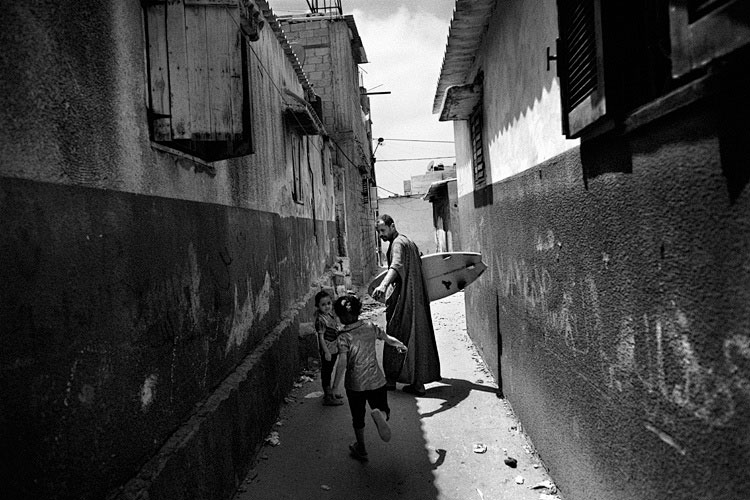
• Children: Respiratory systems are not fully developed, making them more susceptible to particulate matter damage. Two children were injured when a wall collapsed due to strong winds.
• Elderly: Weakened immunity, often accompanied by underlying diseases. Statistical data is lacking, but it is known that large numbers of elderly people are living in tents.
• Chronically ill patients: Dust exacerbates existing conditions. The Civil Defense Authority specifically warned respiratory disease patients not to go outside.
• Pregnant women: Pollutants can affect fetal development. Specific data is lacking, but it is known that many pregnant women are among the displaced.
4. Official Response Recommendations
Facing this health crisis, the Gaza Civil Defense Authority issued detailed protective recommendations:
• Avoid going outside absolutely: Unless absolutely necessary, do not leave homes, shelters, or tents.
• Respiratory protection: When going out is unavoidable, wear a cloth mask or cover the nose with a damp cloth.
• Eye protection: Avoid exposing eyes to dust, especially for those with a history of eye allergies.
• Increase fluid intake: Increase water consumption after breaking the fast and during the night to mitigate the effects of the dusty environment.
• Reinforce tents: Displaced people in coastal areas must reinforce their tents to prevent them from being blown away.
IV. The Deeper Crisis Exposed by the Sandstorm
The reason this sandstorm became major news is not due to its meteorological intensity, but because it mercilessly exposed the deeper crisis in Gaza.
1. Continuing Deaths Under the Ceasefire
Although the ceasefire agreement has been in effect for months, ongoing violations by Israel continue to claim lives. Al-Quds newspaper reported that seven Palestinian citizens were killed and 13 injured in the past 48 hours. Since the ceasefire took effect, the total number of victims has risen to 659 martyrs and 1,754 injured.
More heartbreakingly, a woman from the Abu Shawareb family was killed by occupation forces’ bullets in the Maghazi camp, while two children were injured when a wall collapsed due to strong winds in Khan Younis. The dual blow of war and natural disaster makes civilians the ultimate victims.
2. The Metaphor of “Double Genocide”
The Palestinian Central Bureau of Statistics and the Environmental Quality Authority stated in their World Environment Day 2025 statement: “Israel is committing double genocide: genocide against humanity and against nature.” This sandstorm is a vivid illustration of that accusation—when the environment itself becomes a weapon, when a natural phenomenon turns lethal due to war, the double genocide of humanity and nature is unfolding simultaneously in Gaza.
V. Conclusion: An Invisible Battlefield, Visible Scars
The sandstorm over Gaza will eventually dissipate, and the sky will return to its usual colors. But the scars left by this storm will not disappear—they will remain in the damaged lungs of children, in the nightmares of families who have lost shelter, and in the land that has been hollowed out by war, unable to provide even basic protection for its residents.
When a meteorological “low-pressure system” meets a war-induced “vulnerability system,” a natural disaster ceases to be “natural.” It becomes yet another unpayable debt on war’s ledger—a debt that the children of Gaza will repay with their health, their future, and even their lives.