
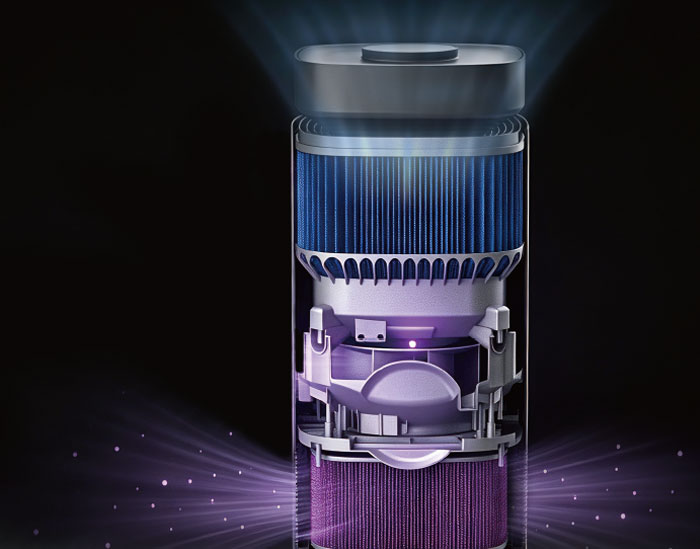
“Water wash” sounds like a humidifier with extra steps. In an air purifier it is a different mechanism: air is forced through a water stage, and the water becomes the surface where particles and soluble gases are captured.
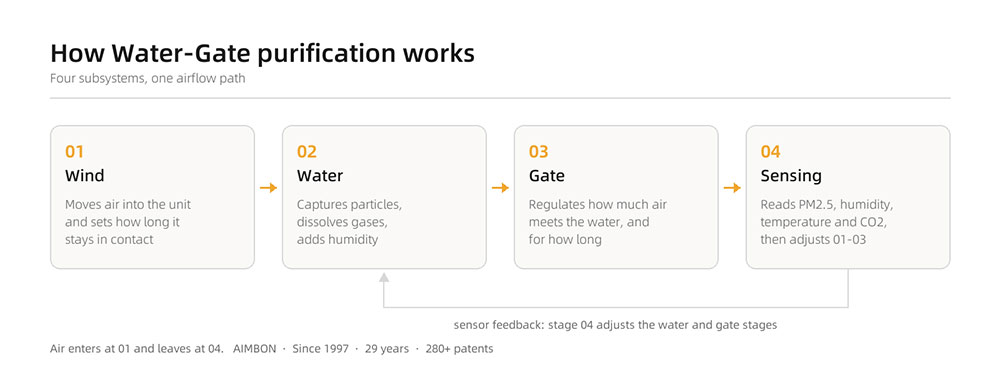
That difference matters, because it decides what the machine is good at and where it stops being the right answer. This is a walk through the four subsystems, in the order the air meets them.
Key takeaways
- Water is a contact surface, not a filter. Capture depends on contact time, not on how wet the unit looks.
- Contact time trades against airflow and noise. The gate stage exists to manage that trade-off.
- Water captures soluble gases well and poorly soluble VOCs less well. That is a chemistry limit, not a marketing one.
- 100 °C sterilisation protects the water loop, not the room. Its job is to stop the machine becoming a biofilm reactor.
- Humidification comes free with the water stage, without white dust, because the water evaporates rather than being atomised.
What “water-gate” actually means
Two words, two jobs. Water is the medium that captures pollutants. Gate is the stage that controls how much air meets that water, and for how long.
The gate is not a mesh or a screen. It is a control element: it regulates the flow between the fan and the water stage, which lets the machine change contact time instead of fixing it at one operating point.
Without that control, a purifier has one design compromise for every condition. With it, the unit can run a different compromise when the room is dirty than when it is quiet.
Stage 1 — Wind: getting air to the water
The fan does more than move air. It sets the velocity through the water stage, and velocity decides contact time.
This is where most of the engineering tension lives. Push more air and the CADR number rises, but each parcel of air spends less time near the water and the fan gets louder. Push less air and capture improves while the room takes longer to clean.
That is why a quiet unit and a high-CADR unit are different designs, not different marketing. Ask which trade-off a model was tuned for.
Stage 2 — Water: capture, dissolve, humidify
Three things happen at the water surface.
Particles impact and stick. Moving air is forced to change direction around water; heavier particles cannot follow the curve and hit the surface. Coarse dust, pollen and pet dander are captured easily. PM2.5 needs more contact time, and PM0.1 is harder still — which is why water platforms usually pair with a dry filter.
Soluble gases dissolve. Formaldehyde and some odour molecules are water-soluble, so they transfer into the water. Poorly soluble VOCs, such as toluene, do not — for those, activated carbon or catalysis is the reliable mechanism.
Water evaporates. Because it evaporates rather than being atomised, minerals stay behind in the tank instead of landing on your furniture as white dust. That is the practical difference between evaporative and ultrasonic humidification.
AIMBON’s implementation of this stage is described in more detail on the Water-Gate technology page, including the T-type wet module and the 100 °C cleaning cycle.
Stage 3 — Gate: the control that makes it work
A fixed fan speed gives a fixed contact time. The gate makes contact time a variable.
By regulating how much air is admitted to the water stage, the unit can hold air near the water longer when particulate levels are high, and open up when the room is clean and noise matters more.
This is also why product descriptions talk about air being released at intervals: the gate stages the flow. Read that as a control strategy, not as a claim that the unit switches itself off.
Stage 4 — Sensing: closing the loop
The sensors read particulate level, humidity, temperature and CO₂, and the controller uses those readings to set fan speed, gate position and humidification output.
Two honest notes. Low-cost particulate sensors drift and need calibration over time. Humidity sensors are only as good as their placement — a sensor sitting in the airflow reads the air leaving the unit, not the air in the room.
Both are reasons to ask a supplier how the sensors are calibrated and where they are mounted, not just which sensors are used.
The whole path in one pass
- Room air enters at the intake; the fan sets its velocity.
- Large particles are stopped by the pre-stage before they reach the water.
- Air meets the water surface; particles impact, soluble gases dissolve.
- The gate holds the air in contact long enough for the current load, then releases it.
- Dry filtration removes what water cannot, including fine particles and poorly soluble VOCs.
- The sensor loop compares the result with the target and adjusts the next cycle.
What water-wash does well, and where it stops
| What you are removing | Mechanism | How well it works | The caveat |
|---|---|---|---|
| Coarse dust, pollen, dander | Impaction on water | Strong | Needs the pre-stage to avoid loading the water |
| PM2.5 | Impaction plus contact time | Good with enough contact | Falls off if airflow is pushed for a bigger CADR |
| Formaldehyde | Dissolution | Partial | Depends on concentration and contact time |
| Odours and VOCs | Dissolution, then carbon | Mixed | Poorly soluble compounds need carbon or catalysis |
| Microbes | Hot-water sterilisation of the loop | Protects the machine | It is not a room steriliser |
| Dry air | Evaporation | Strong | Over-humidification is possible without control |
If your apartment sits next to a new kitchen and formaldehyde is off-gassing for months, a water stage alone is not the whole answer. A dual-stage platform that keeps the dry filter alongside the water module is the more honest configuration.
How to read a water-wash spec sheet
Four numbers tell you whether the design is real, and three of them are usually missing from the catalogue.
- CADR at the speed you will actually use. Headline CADR is measured at maximum fan speed. Ask for the figure at the sleep setting, where the unit spends most of its life.
- Tank capacity against runtime. Divide capacity by consumption to get the refill interval. A four-litre tank that empties in six hours is a daily chore disguised as a feature.
- Contact path. How far does air travel through the water stage? If the supplier cannot describe the path, the “water wash” may be a wetted mesh with a tank underneath.
- Dry-cycle time. How long the unit keeps running after shut-off to dry the wetted path. It is the best single predictor of whether the machine smells after a year.
Maintenance is part of the mechanism
Every wet appliance is a habitat unless it is maintained. The claims in this article only hold if the water is changed, the wetted path is dried between cycles, and the tank is cleaned on schedule.
Skip that, and the machine stops removing odours and starts producing them. Ask any supplier how the unit dries itself after a cycle — if there is no answer, there is no design.

FAQ
Does a water-wash purifier still need a HEPA filter?
At high particulate loads, yes. Water captures coarse and soluble material well, but fine particles need a dry filter to be removed reliably. Most credible platforms run both stages rather than replacing one with the other.
Is water-wash the same as a humidifier?
No. A humidifier evaporates water into the air; a water-wash purifier moves a large volume of air across a water surface to capture pollutants, and humidification is a side effect. Some products combine both functions in one housing, which is where the confusion starts.
Can it remove formaldehyde?
Partially, because formaldehyde is water-soluble and transfers into the water during contact. Performance depends on contact time and on how much is being released. In a newly renovated room with continuous off-gassing, carbon or catalytic filtration is the more dependable mechanism.
Takeaway
Water-gate purification works because four subsystems solve different problems: the fan moves air, the water captures, the gate buys contact time, and the sensors decide how much of each you need right now.
Judge a design by how those four are balanced, not by the presence of water alone. A unit with a large tank and a small contact path is a humidifier with a marketing department.
If you are evaluating water-wash platforms for a product line, send us the room size and the pollutant you actually care about. We will tell you whether a single-stage or dual-stage architecture fits — including when water is the wrong answer.