
The Heart of Innovation: A Deep Dive into Aimbon’s Patented T-Filter and Wet-Dry Dual Core System
At the core of Aimbon’s revolutionary Water-Gate air purification technology lies a unique component: the patented T-shaped water purification filter (T-Filter). This is not just another filter; it is the linchpin of a superior “Wet-Dry Dual Filtration” architecture that redefines how air is cleaned. This article delves into the design and benefits of this proprietary T-Filter and explains why the integrated dry-and-wet system represents a significant leap over conventional single-medium filters.
Part 1: The T-Filter – A Masterpiece of Capillary Engineering
The T-Filter is a marvel of material science and fluid dynamics, designed to transform ordinary water into an active purification membrane.
1. Intelligent Asymmetric Structure:
Unlike uniform filters, the T-Filter features a deliberate “dense at the bottom, sparse at the top” gradient design. This intelligent structure optimizes both water distribution and air resistance. The denser base ensures efficient water uptake through capillary action, while the sparser top allows for maximal air contact with the purification surface.
2. Creation of the Nano Water Film:
The filter is constructed from billions of ultra-fine fibers. Through capillary phenomenon, water is drawn up and evenly spread across this vast fibrous network, forming a stable, nanometer-thick “purification water film.” This massively increases the effective contact area between pollutants and the cleansing medium—equivalent to the surface area of dozens of football fields within a compact filter.
3. Multi-Mechanism Capture and Decomposition:
This nano water film acts as a dynamic, three-dimensional trap:
Dissolution & Absorption: Water-soluble gaseous pollutants like formaldehyde, ammonia, and sulfur dioxide are directly dissolved into the water film.
Interception & Washing: Airborne particles (PM2.5, dust) and insoluble gases are physically intercepted and washed away as air passes through the moist fibers.
Catalytic Degradation: Combined with ozone or ions generated by the system’s “Thunder” module, pollutants trapped in the water film undergo accelerated oxidation, breaking them down into harmless water and carbon dioxide.
Part 2: Why the Wet-Dry Dual Core System is Superior
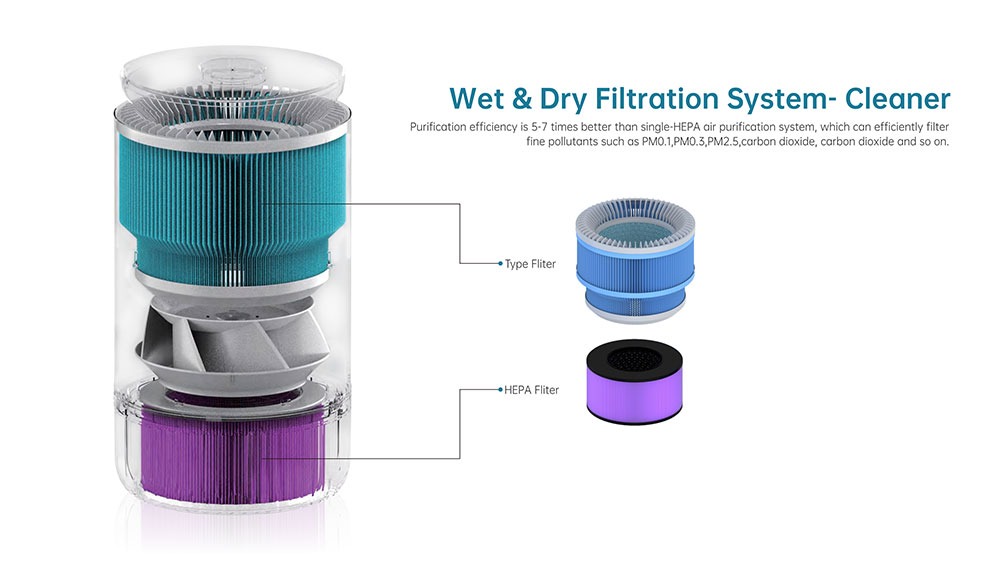
The true genius of Aimbon’s system is the strategic partnership between the Dry Core (Traditional HEPA Filter) and the Wet Core (T-Filter). This synergy creates a more comprehensive, efficient, and durable purification process.
Part 3: The Synergistic Filtration Workflow
First Stage – Dry Filtration (The Coarse Net): Polluted air first passes through the HEPA dry filter. This stage efficiently captures the bulk of airborne particulate matter—dust, pollen, pet hair, and larger PM2.5 particles—protecting the downstream T-Filter from rapid particulate loading.
Second Stage – Wet Filtration (The Molecular Wash): Pre-filtered air then enters the T-Filter core. Here, the remaining ultra-fine particles (PM0.1-0.3) and, most importantly, the gaseous pollutants and odors that passed through the HEPA are confronted. They are dissolved, absorbed, or catalytically destroyed by the nano water film.
Outcome: The air exiting the system is not only particle-free but also significantly reduced in harmful gases and odors, all while being gently humidified. This two-stage, specialized approach ensures each filter type operates at peak efficiency against the pollutants it handles best.
Conclusion: Beyond a Component, A System Philosophy
The Aimbon T-Filter is more than a patented part; it embodies a holistic approach to air health. By intelligently pairing a dry mechanical filter with a wet, reactive purification core, Aimbon’s Wet-Dry Dual Core System solves the fundamental limitations of traditional air purifiers: limited scope, filter saturation, and single-function design.
It delivers triple benefits: unmatched cleaning breadth (particles, gases, microbes), inherent anti-clogging durability, and built-in air conditioning (humidity balance). This makes it not just an incremental improvement, but a foundational shift towards integrated, efficient, and sustainable indoor air wellness.