

When the world’s attention focuses on casualty numbers, displaced families, and shattered infrastructure, another, more silent victim endures irreversible wounds—the natural environment. From the plains of Eastern Europe to the deserts of the Middle East, from Sudan’s forests to Gaza’s Mediterranean coastline, war is destroying ecosystems at an unprecedented scale, poisoning air and water, and leaving ecological legacies that persist for decades or even centuries after peace is restored.
The Multiple Pathways of War’s Environmental Destruction
War’s impact on the environment is not a single dimension of damage but a compound crisis exerted through multiple pathways simultaneously.
Direct Military Action and Ecological Trauma
The most visible form of destruction comes from direct military operations. Explosives release heavy metals and toxic chemicals that seep directly into soil and groundwater. Craters reshape landscapes. Military vehicles crush vegetation. In Gaza, within a narrow 365-square-kilometer strip, nearly 42 million tons of rubble now cover the land—including unexploded ordnance, human remains, and hazardous materials like asbestos. Bombardment has “very likely” contaminated soil with heavy metals and chemicals from explosives and other munitions.
Collateral Damage to Industrial and Energy Facilities
Attacks on industrial sites often trigger environmental disasters far beyond the immediate blast zone. In Ukraine, Russian strikes have frequently targeted industrial facilities across the country—grain elevators, oil depots, ports—igniting fires and causing chemical leaks. Toxic substances spread with smoke and seep into groundwater with rain. The destruction of the Kakhovka Dam in 2023 flooded hundreds of square kilometers of land, dispersing chemical pollutants and other hazardous substances into the surrounding environment, causing widespread damage to ecosystems and biodiversity.
Secondary Environmental Crises
When millions are suddenly displaced, already fragile local water, sanitation, and ecosystems face unimaginable stress. In Sudan, hundreds of thousands of displaced people fleeing to the Northern State have been forced to use charcoal or firewood as alternatives to increasingly unavailable cooking gas, leading researchers to record a sudden surge in deforestation. The economic collapse triggered by war has pushed the unemployed toward illegal logging; Khartoum State has already lost 60% of its vegetation cover.
Ecological Catastrophe in Active War Zones
Ukraine: From Black Earth to Contaminated Zone
Ukraine has long been called the “breadbasket of Europe,” its fertile black soil feeding an estimated 400 million people worldwide. Yet nearly three years of full-scale war are transforming this rich farmland into a belt of heavy metal contamination.
A quarter of the country’s territory has been directly damaged by conflict, and about 30% of protected environmental areas have been destroyed. In the Kherson region alone, economic losses from air pollution exceed 146 billion hryvnias. Coal mines in the Dnipropetrovsk region have been flooded; at least 39 mines have been rendered inoperable by the conflict—before the war, some of these mines were used to store toxic waste, and one was even the site of a Soviet-era underground nuclear explosion.
The Black Sea ecosystem has also suffered devastating blows. Data from Ukraine’s National Academy of Sciences shows that due to Russian aggression, Ukraine has lost control of over 272,000 hectares of protected waters along the Crimean coast and the Azov Sea basin. The Danube Biosphere Reserve frequently records oil pollution and leaks from sunken ships. A single drone strike–ignited fire on January 2, 2026, caused an estimated 130 billion hryvnias in ecological damage.
Yet war has also brought an unexpected ecological paradox: with reduced human activity, marine ecosystems are quietly recovering in some areas. Scientists have observed sturgeon populations reappearing near Zaporizhzhia and Khortytsia Island—a sight unseen for decades.
The Gaza Strip: From Habitable Land to Ecological Exclusion Zone
Even before the current war, Gaza’s environmental situation was precarious due to severe soil, water, and air pollution, as well as chronic shortages of clean drinking water after more than 16 years of blockade. The war that began in October 2023 has pushed this fragile land to the brink of ecological collapse.
Access to clean water has decreased by 94%, dropping to less than five liters per person per day—far below the World Health Organization’s minimum standard. 84.6% of critical water and sanitation infrastructure has been damaged, and not a single wastewater treatment plant or seawater desalination facility can operate normally. Untreated sewage seeps directly into groundwater aquifers, contaminating already scarce freshwater resources.
Due to overcrowded living conditions and lack of sanitation, infectious disease transmission has increased fivefold compared to pre-war levels, including the resurgence of polio in 2024. The World Health Organization has documented alarming increases in communicable diseases, while the already overwhelmed health system is completely unable to cope.
The rubble itself has become a massive ecological threat. By 2024, approximately 42 million tons of debris covered the Gaza Strip—more than one ton of rubble piled onto every square meter of land. This debris is mixed with unexploded ordnance, asbestos, heavy metals, and other toxic substances. In Gaza City, a massive garbage mound exceeding 300,000 cubic meters has swallowed the once-bustling Furas Market, becoming “a symbol of this two-year-long war.”
Environmental experts fear that environmental destruction on this scale may render Gaza uninhabitable: “We don’t have all the data yet, but preliminary data tells us many areas will be impossible to restore.”
Sudan: From Forest Treasure to Deforestation Frontline
Sudan’s conflict is not only claiming lives but also strangling the forests that sustain them. The Soot Forest south of Khartoum, once a 1,500-hectare nature reserve, has now “completely disappeared.”
This forest was once a paradise for migratory birds and a green barrier against seasonal Nile flooding. More than a hundred bird species—including ducks, geese, terns, ibises, herons, eagles, and vultures—along with monkeys and small mammals, once thrived here. Today, towering acacia trees have vanished, replaced by bare, barren land dotted with people scavenging for residual wood.
“This is systematic destruction,” says Khartoum State’s environmental affairs official. With economic collapse and security vacuums caused by war, illegal logging has spread across Darfur, Kordofan, Sennar, and Gezira regions. Agencies responsible for forest protection cannot access most areas, rendering bans meaningless.
The consequences of losing forest barriers will be catastrophic. Agronomists warn this will lead to more severe seasonal flooding—floods that already destroy homes, farmland, and infrastructure across Sudan every year, forcing countless families to flee.
The US-Iran Conflict: A New Ecological Front in the Persian Gulf
The latest escalation between the United States and Iran, beginning in late February 2026, has added a dangerous new dimension to the Middle East’s environmental crisis [citation:5]. What was once geopolitical tension has rapidly transformed into direct military confrontation with potentially catastrophic ecological consequences for the entire Gulf region.
The Persian Gulf: A Powder Keg of Environmental Risk
The Persian Gulf is not just a strategic waterway—it is one of the most ecologically sensitive and fragile marine environments on Earth. A semi-enclosed, shallow sea with limited water exchange, it takes years for the Gulf’s waters to fully flush into the open ocean. Any major pollution event here does not dissipate quickly; it circulates, concentrates, and settles, poisoning ecosystems for decades [citation:1].
This region is densely packed with oil rigs, gas platforms, petrochemical plants, and critical desalination facilities that provide drinking water for millions across the Gulf states. When military operations target or endanger these facilities, the environmental stakes become existential [citation:1].
The Immediate Fallout: Attacks Across the Gulf
Since February 28, 2026, the conflict has spilled across the entire Persian Gulf, with direct environmental consequences already visible [citation:1]:
• In the UAE, Dubai’s international airports were forced to suspend all flights. A terminal at Dubai International Airport was hit by missile debris, causing fires and injuries. The iconic Burj Al Arab hotel and a hotel on Palm Jumeirah also caught fire. In Abu Dhabi, an intercepted Iranian drone crashed, killing one person and injuring seven [citation:1].
• Kuwait closed its airspace and suspended operations at the Shu’aybah commercial port. An airbase in northwestern Kuwait was hit by multiple ballistic missiles, and a naval base in the south was struck by a drone. Fragments from intercepted missiles caused fires and injuries across the country [citation:1].
• Qatar’s capital Doha repeatedly echoed with explosions from intercepted missiles. Although most missiles targeting US bases in Qatar were intercepted, debris still ignited fires in multiple locations and injured 16 people [citation:1].
• In Bahrain, the US Navy’s Fifth Fleet base in Manama came under sustained missile attack from Iran. Residential areas were evacuated, and the international airport was affected. Missile debris caused a ship to catch fire in Salman City, killing one person and critically injuring two others [citation:1].
• Saudi Arabia experienced missile strikes targeting US military facilities in Riyadh Province and the Eastern Province, though all were reportedly intercepted [citation:1].
The Strait of Hormuz: Closing the World’s Energy Lifeline
Perhaps the most significant environmental threat from this conflict is the situation in the Strait of Hormuz. On February 28, Iran’s Islamic Revolutionary Guard Corps announced the closure of the Strait, warning that it was no longer safe for any vessels to pass through [citation:5][citation:8].
The Strait of Hormuz connects the Persian Gulf with the Gulf of Oman and is the only passage for oil exports from Saudi Arabia, Iraq, Qatar, the UAE, and other Gulf producers. Approximately one-fifth of the world’s total oil trade passes through this narrow waterway [citation:5]. With the Strait now effectively closed, major shipping companies including Denmark’s Maersk have suspended crude oil, fuel, and LNG transport through the region [citation:8].
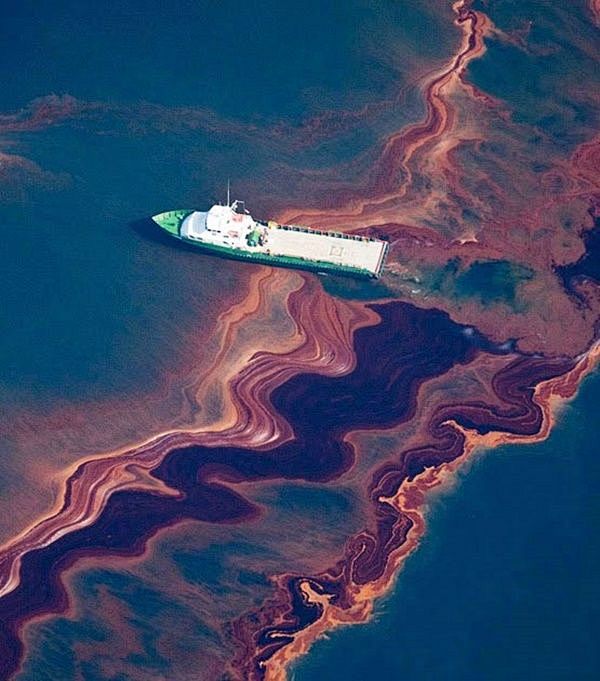
The environmental implications are profound. Any attack on the dozens of tankers still in the Gulf, or on the oil terminals dotting its coastline, could unleash a catastrophic oil spill. The Gulf’s shallow, enclosed waters would trap the oil, smothering coral reefs, destroying mangrove forests, poisoning fisheries, and clogging the intakes of desalination plants upon which millions depend for fresh drinking water [citation:1].
Civilian Infrastructure and Environmental Damage
The conflict has already directly damaged civilian infrastructure with environmental consequences. In Iran, multiple hospitals have been struck or damaged by blasts, including the Gandhi Hospital in Tehran and the Aboozar Children’s Hospital in Ahvaz [citation:9]. A primary school in Minab, southern Iran, was hit by a missile strike that killed at least 165 people, mostly young girls [citation:5][citation:9]. Beyond the immediate human tragedy, attacks on such facilities risk releasing asbestos, coolants, and other hazardous materials into the environment.
Iran’s UNESCO-listed Golestan Palace in Tehran was also damaged by shockwaves from nearby blasts, shattering windows, doors, and mirrors [citation:9]. Cultural heritage sites, once destroyed, represent an irreversible loss to human civilization—another dimension of war’s environmental and cultural devastation.
A Multi-Country Pollution Crisis
The conflict has drawn in multiple nations across the region, each now suffering environmental consequences [citation:1]. In Iraq, the Popular Mobilization Forces headquarters in Babylon province was struck, and explosions rocked Erbil near the US consulate and a base hosting US forces [citation:1]. In Jordan, missile debris fell across multiple areas, causing property damage [citation:1]. In the West Bank, windows and doors shook with each explosion from intercepted missiles [citation:1].
Each of these strikes leaves behind physical debris—unexploded ordnance, missile fragments, contaminated rubble—that will persist in the environment long after the fighting stops. The lead, explosives, and other toxic materials embedded in this debris will slowly leach into soil and groundwater, poisoning communities for years to come.
Iraq: The Legacy of “Forever Chemicals”
Decades of successive conflicts have left Iraq grappling with a toxic legacy of “forever chemicals”—Persistent Organic Pollutants (POPs) that do not break down in the environment. These toxins migrate through the food chain, causing severe health defects and staggering economic losses [citation:10].
National assessments have identified critical contamination zones across Iraq, including aging storage facilities leaking hazardous agricultural chemicals, industrial pollutants embedded in the nation’s power infrastructure, and high-risk zones created by unregulated waste burning and industrial discharge. The environmental crisis costs the Iraqi economy an estimated US$1.4 billion annually [citation:10].
Critically, this toxic burden falls most heavily on those least able to defend themselves: displaced families, women, youth, and rural communities whose livelihoods depend directly on clean land and water [citation:10].
In response, in February 2026, Iraq’s Ministry of Environment and the United Nations Development Programme signed a landmark agreement to launch the Integrated Persistent Organic Pollutants and Chemical Hotspots Management Project, marking a decisive shift from assessment to direct field action [citation:10]. But for the millions already exposed, the damage is done.

The Global Climate Bill of War
The ecological cost of war extends far beyond the conflict zones themselves. At a time when climate change poses an existential challenge to all humanity, war is a dangerously underestimated source of carbon emissions.
Research shows that between 2022 and 2024, the war in Ukraine generated over 230 million tonnes of CO₂—equivalent to the annual emissions of a country like Colombia. Military operations themselves accounted for 36% of that total, while reconstruction and infrastructure damage made up another 27%. Wildfires sparked by shelling contributed 21% [citation:3].
In Gaza, researchers estimate that the first 15 months of fighting produced more than 32 million tonnes of CO₂. The rebuilding process could emit between 46 and 60 million tonnes more—a devastating addition to global totals at a time when the world urgently needs to reduce emissions [citation:3].
And the world’s largest institutional consumer of fossil fuels is precisely the defense sector. Since September 11, 2001, US military operations globally have generated 1.3 billion tonnes of CO₂ equivalent. Operations in Afghanistan, Iraq, Pakistan, and Syria alone contributed approximately 440 million tonnes, with the 2003 invasion of Iraq responsible for 250 million tonnes [citation:3].
Yet shockingly, the Paris Agreement does not require countries to record or report their military emissions. This “military emissions gap” means that approximately 5.5% of global greenhouse gas emissions—more than the entire aviation and shipping industries combined—remain outside the international climate governance framework [citation:3].
Legal Accountability for Environmental Destruction
The environmental wounds of war are so deep and enduring that the international community is finally beginning to confront the issue. In July 2025, the International Court of Justice issued a landmark advisory opinion on states’ obligations to tackle climate change, concluding that countries must take “all necessary measures” to prevent harm to the climate and to cooperate internationally—which should include assessing and reporting emissions linked to armed conflict [citation:3].
The UN International Law Commission has also developed draft principles for the protection of the environment in times of war, calling on states to integrate environmental protection into military planning. However, as with many international law frameworks, implementation depends on political will—something that tends to vanish in wartime [citation:3].
More ambitious is the push to establish “ecocide” as a crime under international law—alongside genocide and crimes against humanity. The term refers to unlawful or wanton acts committed with knowledge that they are likely to cause severe, widespread, or long-term damage to the environment. Currently, only a handful of countries including Belgium, Mexico, and Vanuatu have moved toward codifying ecocide in domestic law [citation:3].
“If the destruction of ecosystems is treated as a crime, it changes the calculation for decision-makers,” argue supporters. “It introduces a deterrent effect—a reminder that environmental damage isn’t collateral, it’s criminal” [citation:3].
Conclusion: The Ultimate Price of War
From the coal mines of Donbas to the coastlines of Gaza, from the forests of Khartoum to the wetlands of the Dnieper, and now to the oil-saturated waters of the Persian Gulf, war is destroying Earth’s life support systems at an unprecedented pace. This destruction does not end when the guns fall silent—heavy metals will remain in the soil for decades, unexploded ordnance will sleep in fields for centuries, biodiversity losses may take millennia to recover.
On the International Day for Preventing the Exploitation of the Environment in War and Armed Conflict, experts issue a warning: the environment is often the silent victim of war. Environment and human life are inextricably connected—it concerns livelihoods, public health, access to clean air and water, the sustainability of food systems. The environmental impacts of war are typically not confined within a single country’s borders; rivers flow where they will, winds blow where they please—these are issues that cross national boundaries [citation:3][citation:4].
When we calculate the cost of war, we must not forget this silent victim. Because ultimately, the cost of restoring destroyed ecosystems will be borne by all survivors—regardless of where they live, regardless of which side they were on. As the World Economic Forum’s Global Risks Report 2026 makes clear, environmental risks—extreme weather, biodiversity loss, ecosystem collapse, critical changes to earth systems—remain the top three risks on a ten-year horizon [citation:4]. War only accelerates our collective race toward these precipices.
If future peace agreements included commitments to environmental restoration and emission reduction, conflict recovery could also become a path to planetary healing. Until then, the world continues to fight two battles at once: one against each other, and one against time [citation:3].